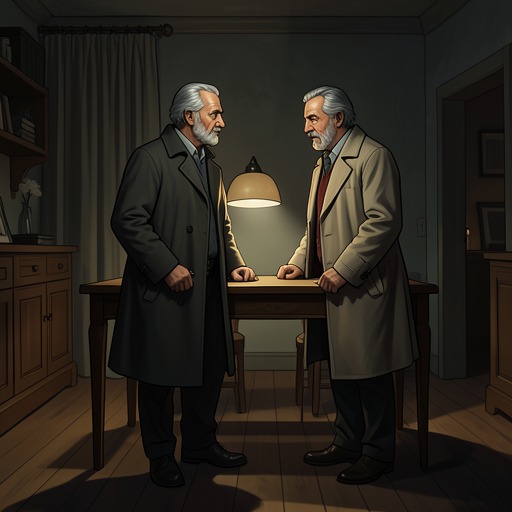
Mikhail Fyodorovich Mindich
A Gentleman in MoscowMikhail Fyodorovich Mindich, usually called Mishka, is Count Alexander Ilyich Rostov’s oldest friend and a writer whose restless intellect persists through separation, political upheaval, and death. Their friendship begins in youthful conflict and grows through a shared appetite for ideas, but its final form is an unfinished life preserved in a hand-bound volume of poetry. When Mishka dies, the book he sends to the Count becomes more than a literary inheritance: it carries a photograph of their youth and marks the loss of the last person who remembered the Count before the Metropol became his world.
Identity and Early Friendship
Mikhail and the Count first meet at Imperial University in Saint Petersburg in the fall of 1907. They seem unlikely companions. The Count has grown up in a twenty-room mansion attended by fourteen staff members and is celebrated in the capital’s salons for wit, intelligence, and charm. Mikhail, raised with his mother in a two-room apartment, is scarcely known beyond his preference for reading alone rather than spending evenings in frivolous conversation. Their different backgrounds do not prevent recognition: they are drawn together by what each can offer the other, and by the physical courage that initially brings them into contact.
On the fourth day of their first year, Mikhail throws himself into a dispute despite being outnumbered, while the Count instinctively defends the disadvantaged man, even when the cause is ill-conceived. The encounter ends with both helping each other to their feet, brushing dust from their knees and blood from their lips. Their friendship thus begins not in polite agreement but in a shared scrape. In the days afterward, the Count listens to Mikhail’s impassioned ideals, while Mikhail hears about the city’s salons; within a year, they are sharing rented rooms above a cobbler’s shop off Sredny Prospekt.
Temperament and Literary Ambition
Mikhail’s pacing is the most visible expression of his restless nature. He can wear out shoes while walking the length of a small room, and the narrative imagines him pacing extraordinary distances even in an opera box or confessional. Books intensify rather than quiet this energy. He may refuse invitations to dinners or dances because he has found a volume that must be read immediately, yet after only fifty pages he can leap up to pace and argue with its thesis, style, or punctuation. When the Count returns late, Mikhail may have made little progress through the book but worn through his shoes in the process.
This mixture of solitude and fervor carries into his public hopes for literature. During a visit to the Count at the Metropol, after they have toasted the Grand Duke and recalled the past, Mikhail turns to the coming congress of the Russian Association of Proletarian Writers. He imagines writers with sharply different styles, including Akhmatova, Bulgakov, Mayakovsky, and Mandelstam, gathering to forge a new poetry centered on the human spirit and the future. As he develops the idea, he gets to his feet and paces from corner to corner of the Count’s small study, as if thinking aloud in the privacy of his own apartment. His vision is expansive: a poetry that is universal, unhesitating, and independent of kowtowing. The scene joins his characteristic physical restlessness to a belief that literary form might open a common space for writers otherwise divided by fear and difference.
Separation, Work, and Devotion
Mikhail’s sudden arrival at the Metropol surprises the Count, although his energetic intrusion into a hotel suite is entirely in character. Mikhail has recently received a new appointment at their alma mater in Saint Petersburg, but his appearance in the hotel is unexpected and he arrives in a state that unsettles his friend. The Count recognizes the continuity beneath the change: the same ragged beard and restless pace remain, despite the years and a few additional pounds.
Later, the narrative places Mikhail in the village of Yavas, where he sits at a table in a rented room by candlelight, sewing together another sixteen-page signature for a book. The image gives his literary labor a material, painstaking form. Elsewhere, a young architect’s private drawings and a musician’s work for Sofia show how people preserve their aspirations when ordinary circumstances obstruct them; Mikhail’s pages belong to this same pattern of persistence. His writing is not presented as an abstract ambition but as a handmade object, assembled page by page in a small room.
Katerina Litvinova eventually tells the Count that she received word from Mikhail in January, went to Yavas, and had been with him for the last six months. She has come to the Metropol at Mikhail’s request, carrying something he wanted delivered to his old friend. When the Count describes Mikhail as loyal, Katerina corrects the description: he was a man of devotions. The Count recognizes the precision of her account. He had been about to recall Mishka’s scrapes and incessant pacing, but her words reach beyond those familiar traits to name the constancy beneath them. He adds that Mikhail was a fine poet; Katerina answers that he was one of two, a brief exchange that gives the Count’s bereavement the shape of a shared artistic history.
Death and Literary Legacy
Katerina brings a rectangular package wrapped in plain brown paper and tied with twine. Its weight tells the Count that it is a book. After she leaves, he unwraps it to find a small leather volume titled Bread and Salt. Its roughly cut pages and loose threads reveal that Mikhail bound it himself. The handmade book gathers the acts that have defined him: writing, making, and sending his work to a friend who might otherwise have known only that he was gone.
Inside the book is a photograph taken in 1912 at the Count’s insistence and to Mikhail’s chagrin. The young Count stands in a top hat, with a glint in his eye and a moustache extending beyond his cheeks; Mikhail stands beside him as if ready to sprint out of the frame. The photograph’s contrast recalls the two temperaments that first drew them together, while its survival shows that Mikhail kept an image he had once resisted. It joins his final volume to the shared past the Count has lost.
As the Count reads, he recognizes Mikhail’s characteristic feistiness in the project. After a passage from Fyodor Dostoevsky’s The Brothers Karamazov, he encounters another citation, this time concerning Ilyushechka, the bullied boy who falls dangerously ill. The boy’s final request asks that bread be crumbled on his grave so sparrows will visit and he will not lie alone. The passage does not simply decorate Mikhail’s book: it brings together the volume’s title, its concern with an unjust world, and the compassion that the Count understands in his friend. Mikhail, like the child in the cited passage, had not been inclined to condemn the world for its injustices.
The Count breaks down in tears for Mikhail, whose generous but temperamental nature had only briefly found its moment in time. He also weeps for himself. His friendships with Marina, Andrey, and Emile, his love for Anna, and his bond with Sofia remain, but Mikhail’s death removes the last person who knew him as a younger man. Katerina’s final instruction is to remember him. The book, the preserved photograph, and the Count’s act of reading give that instruction its form: Mikhail is gone, but his words and the memory he shared with the Count remain in the hands of the friend who can still bear witness to him.